

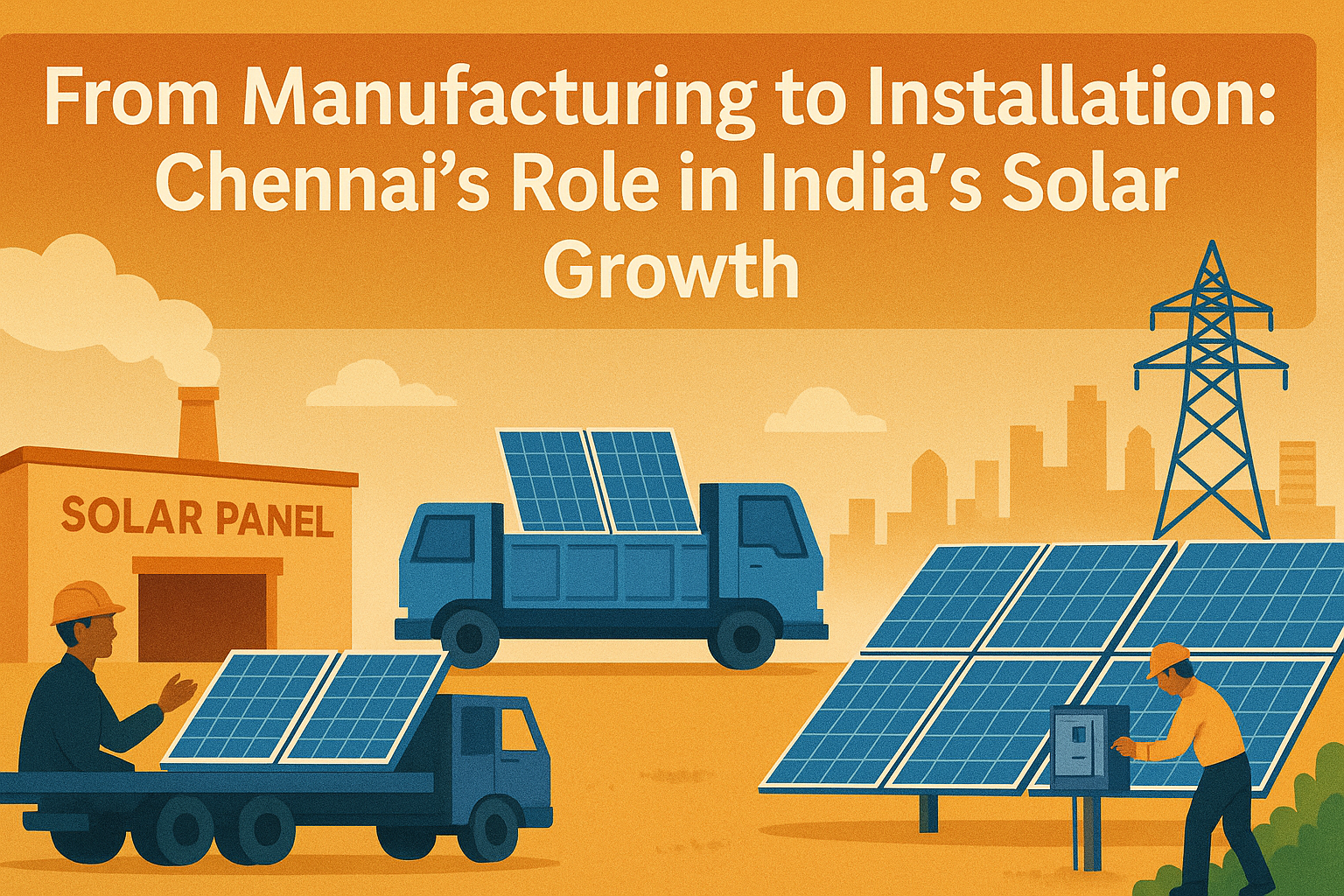
From Manufacturing to Installation: Chennai’s Role in India’s Solar Growth
Introduction
Chennai has always been known as an industrial hub — home to automobile giants, technology parks, and ports that connect India to the world. Over the past few years, a new identity has been added to that list: a solar powerhouse.
From factories that produce high-efficiency panels to local companies that install them on rooftops, Chennai is helping India move toward a cleaner and more reliable energy future.
1. How Chennai Became a Solar Manufacturing Hub
The city’s advantage lies in its mix of infrastructure, skilled labor, and coastal access. Manufacturers can easily ship materials in and out, while engineering talent from local universities supports innovation.
Several solar panel manufacturers in Chennai now produce modules designed specifically for India’s hot and humid climate. These factories build panels that resist corrosion, handle high temperatures, and deliver strong performance even under partial shade — perfect for South Indian rooftops.
2. Why Local Manufacturing Matters
Until recently, most of India’s panels were imported. Local production in Chennai changes that story by offering:
- Lower logistics costs and faster delivery
- Custom designs that suit Indian roofs
- Better after-sales support since the factory and the buyer are in the same state
More importantly, manufacturing here keeps profits and jobs within India — supporting the country’s goal of energy self-reliance.
For a broader state view, read about solar panel manufacturers in Tamil Nadu who are powering the region’s clean-energy economy.
3. From Factory Floor to Rooftop: The Installation Network
Manufacturing is only half the story. Chennai’s local installers turn those panels into working power systems for homes, schools, and offices across the city.
A typical project follows a simple flow:
- Site visit – technicians measure the roof and energy needs.
- Design & quotation – engineers plan layout and estimate generation.
- Installation – mounting, wiring, and inverter setup.
- Net-metering – linking the system to the grid so excess power earns credits.
Because everything — panels, technicians, and approvals — is available locally, installations move quickly and smoothly.
Curious how the process works in detail? Explore solar panel installation in Chennai for a full step-by-step guide.
4. The Economic Ripple Effect
Chennai’s solar ecosystem supports thousands of jobs — not just in factories, but in transport, construction, and maintenance.
- Small workshops build mounting frames and junction boxes.
- Electrical contractors handle wiring and safety checks.
- Technicians provide cleaning and service through annual maintenance contracts.
This combination of manufacturing and services has turned solar into a long-term employment engine, especially for young engineers.
5. Why Businesses Are Choosing Solar in Chennai
For industries, solar energy is no longer just about being green — it’s about staying competitive.
Factories and IT parks now install rooftop systems to cut costs and meet corporate sustainability goals. Many have adopted hybrid setups with batteries to maintain power during outages.
The result? Lower operational expenses, stable supply, and improved ESG ratings that attract global clients.
To see how large projects are managed end-to-end, read about solar EPC companies in Tamil Nadu leading industrial-scale installations.
6. Benefits for Homeowners Too
It’s not just industries that benefit. More Chennai residents are turning their rooftops into mini-power stations.
- Lower electricity bills: Solar offsets daytime usage immediately.
- Protection from tariff hikes: Once installed, power cost stays predictable.
- Reliable backup: Hybrid systems provide electricity even during blackouts.
- Greener lifestyle: Every 1 kW system reduces nearly a ton of carbon emissions annually.
Thinking about starting small? Our beginner’s guide to solar power systems in Chennai explains which setup fits your home best.
7. Government Support and Future Outlook
The Tamil Nadu government continues to push solar adoption through incentives and simplified net-metering.
With upcoming policies focused on energy storage, smart meters, and EV-charging integration, Chennai is expected to stay at the center of India’s clean-tech map.
Manufacturers are already exploring new technologies like TOPCon and bifacial panels, which can generate electricity from both sides. As these innovations reach the market, system efficiency will rise while costs continue to drop.
8. Challenges to Overcome
Despite the progress, there are still areas to improve:
- Public awareness about subsidies and financing options is low.
- Some older buildings require roof strengthening before installation.
- Skilled labor shortages can slow down large rollouts during peak demand.
Addressing these challenges through better training and policy outreach will help Chennai scale its solar capacity even faster.
Conclusion
From panel manufacturing lines to rooftop installations, Chennai is showing how a single city can influence an entire nation’s energy direction. The combination of technology, talent, and sunlight makes it a natural leader in India’s solar journey.
If you’re considering switching to solar — whether for your home or your business — start by connecting with certified solar companies in Chennai.
They’re the bridge between the city’s thriving factories and your rooftop, turning Chennai’s sunlight into long-term savings and a cleaner tomorrow.